The Arctic is not the same ice pack as it was decades ago, we have now arrived at a state where the ice pack is mainly first year ice.
Wednesday, 30 May 2012

Tuesday, 8 May 2012
Heatland F**k Up Big Style.
This whole Heartland posters furore bores me. Like the rest of the thrashings of the denialist zombies it's all rather passe. That hasn't stopped me reading other blogs about it. But the best summary I've read so far is from my 'blogroll'. I recommend taking a couple of minutes to read Lazarus: Hitler Liked Dogs. Do You? Basically Heartland have dropped a clanger, even drawing flak from Ross McItrick, Lazarus has some graphics that put things in context.
For those puzzled by the Thatcher billboard mock up over there - Yes Conservative Prime Minister Margaret Thacher, with a background in research chemistry, was one of the first world leaders to really grasp what the climate scientists were saying. She spoke at the Second World Climate Conference, and instituted the Hadley Centre. During that opening she addressed Dr Houghton, head of the IPCC:
For those puzzled by the Thatcher billboard mock up over there - Yes Conservative Prime Minister Margaret Thacher, with a background in research chemistry, was one of the first world leaders to really grasp what the climate scientists were saying. She spoke at the Second World Climate Conference, and instituted the Hadley Centre. During that opening she addressed Dr Houghton, head of the IPCC:
Your Report confirms that greenhouse gases are increasing substantially as a result of Man's activities; that this will warm the Earth's surface, with serious consequences for us all, and that these consequences are capable of prediction. We want to predict them more accurately and that is why we are opening this Centre today.Just goes to prove, people can have right wing viewpoints without losing touch with evidence and reason.
Source.
Thursday, 3 May 2012
CO2 Causes Arctic Sea Ice Loss.
The reason I've not been blogging much recently is because I've been spending time in discussion threads, mainly at RealClimate and Neven's Sea Ice Blog. However news posted at Neven's a recent paper offers the opportunity to make a blog post, and an apology. The paper concerned is "Observations reveal external driver for Arctic sea-ice retreat" by Notz & Marotzke, as usual there's a copy to the actual paper at the end of this post.
Tuesday, 17 April 2012
That mid month miscellanea post again...
Firstly here are two excellent videos from Greenman AKA Peter Sinclair of Climate Crocks. Part 1 and Part 2. As usual I give links to videos as I've still not figured out how to make the Blogger player window large enough for details. The videos are about the recent weird weather and links to the Arctic, there are interviews with a stack of scientists, and clips from the recent Horizon programme on Global Weirding. Total time is only 20 minutes, they really are a must see.
As an aside, it's interesting that the clips from news and TV are from the BBC, yet most of the scientists and meteorologists interviewed are American. I suspect the media in the US aren't serving their audience a diet of reality.
Over at RealClimate there's a post by Axel Schweiger, Ron Lindsay, and Cecilia Bitz on the use of extrapolations of PIOMAS volume, here. The basic message - such extrapolations aren't of much use. I'm of a similar view, I think the comment that sums up my view on extrapolation is "You might as well draw the Arctic’s horoscope."
Over at RealClimate there's a post by Axel Schweiger, Ron Lindsay, and Cecilia Bitz on the use of extrapolations of PIOMAS volume, here. The basic message - such extrapolations aren't of much use. I'm of a similar view, I think the comment that sums up my view on extrapolation is "You might as well draw the Arctic’s horoscope."
Tuesday, 10 April 2012
CO2's role in the end of the Last Glacial
A recent paper by Shakun et al may throw new light upon the role of CO2 in the past glacial and interglacial periods. What does it mean, and does it change the situation we face with regards the current era of anthropogenic global warming, driven in large part by human emissions of CO2?
Friday, 6 April 2012
Anticipation...
PIOMAS March volume data is now out, as anticipated the daily anomalies show nothing special with volume tracking close to last year.
The following graph is of daily volume anomalies, I've calculated the average for each day from 1980 to 1999, the value plotted on the graph is the difference from the average. Click on the graph to see the years, the general trend is down, with 2010 and 2011 showing the greatest drops, 2012 so far being the incomplete purple line.
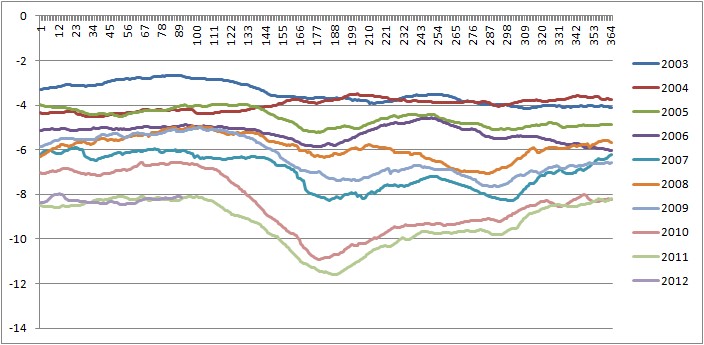
The first indications of whether we'll see another anomalous volume drop this Spring will come early May when the PIOMAS volume data is out for April. Will see see another drop? If we do, what will that mean?
The first indications of whether we'll see another anomalous volume drop this Spring will come early May when the PIOMAS volume data is out for April. Will see see another drop? If we do, what will that mean?
Once is happenstance. Twice is coincidence. The third time it's enemy action.The anticipation is killing me...
Sunday, 1 April 2012
Musings on Models
In 2006, a year before the massive Arctic Crash of 2007, Marika Holland, Cecilia Bitz, and Bruno Tremblay presented a paper entitled "Future abrupt reductions in the summer Arctic sea ice" to Geophysical Research Letters, it was published later the same year. In that paper (Holland et al) an examination of rapid sea-ice loss periods in models used for the IPCC's Fourth Assesment Report was carried out. Holland et al fnd that a general message from the suite of simulations is that the harder humans force the climate, the faster the sea-ice goes, an observation that for readers of this blog may seem trite.
More interesting, especially in the light of the aftermath of 2007 and the clear failure of IPCC models to reproduce the observed rate of ice loss in the Arctic, is whether the models still tell us something of value about the changes we are seeing in the Arctic.
More interesting, especially in the light of the aftermath of 2007 and the clear failure of IPCC models to reproduce the observed rate of ice loss in the Arctic, is whether the models still tell us something of value about the changes we are seeing in the Arctic.
Subscribe to:
Posts (Atom)