Showing posts with label AGW. Show all posts

Thursday, 21 July 2022

The Normal Distribution and a Recent UK Temperature Record.

We have had some really weird hot weather here (UK), and I've been looking at the Central England Temperature Series (CET). This is an event that is but a small part of a massive heatwave impacting Europe...

Again.


Monday, 21 March 2022

Arctic Ocean: A New Ice Pack

Just a quick first review of PIOMAS data from 1978 to 2021. The results of this preliminary data-dive are what I had expected, which is not good.

Sunday, 20 March 2022

England and Wales Rainfall

In 2016 I posted about UK rainfall and found that by the measure used the probability of a very wet year had increased in recent decades to 3/6 from a prior frequency of 1/6. In this post I revisit that work using an improved demarcation for wet and very wet.

What I have now found is a change of precipitation around 1998, before which the joint probability of a wet or extreme wet year has now risen from 18% prior to 1998 to 58%, a three-fold risk increase, in line with my 2016 work. 

This is a substantial change with serious implications for human impacts such as flooding.

Sunday, 20 December 2015

2015 Record Temperature Smash

In October I posted the results of calculations that show that 2015 is very likely to be a new record warm year. That was based on data to September, now I have data to November and 2015 will be a new record likely by a massive margin.

Sunday, 13 December 2015

COP21

In Paris the Great and Good have met and decided that it would be a good idea to keep AGW to below 1.5 to 2 degC. We'll see how that pans out, any effect will be seen in the coming decades in the rate of increase of atmospheric CO2, which is currently running at about 2ppm/yr.

Whilst the COP21 talks were ongoing, what seems to me to be a more important item of news (in terms of dealing with AGW) has been announced. Engineers and scientists in Germany reported what seems to me (as an outsider) to be a potentially exciting development in fusion power.


Monday, 23 November 2015

Is Prince Charles Correct?

In an interview recorded before the recent Paris massacre Prince Charles has recently told Sky News that he thinks that Climate Change is one causal factor in the ongoing Syrian situation. Rejecting him out of hand does not seem sound to me based on the available evidence.

Sunday, 18 October 2015

A High Probability of 2015 record for GISS LOTI

Before I settle down for a Sunday afternoon watching films recorded during the week, a thought occurred to me: What is the current situation regarding global average temperature?

Saturday, 2 May 2015

Is Arctic Sea Ice Like a Cup or a Ball?

As posted at Neven's blog, Wagner and Eisenman have recently published a paper building on an active area of research into whether the loss of sea ice will be linear or non linear. Thanks to Neven for bringing my attention to this paper and to HotWhopper for the link to a pre-print of Wagner & Eisenman. Although HotWhopper almost negates the provision of the actual paper by giving a guided tour of some comments at Dumbass Central. ;)


Sunday, 4 January 2015

UK Rainfall 2014, a sneak peek.

I just, rather optimistically, checked UK rainfall data to see if it had been updated. It hasn't, but I was reminded that while the annual data is for January to December, the seasons run from December to November (using meteorological seasons). The main index I will continue to use will be the calendar year, January to December, but while I wait for PIOMAS data, here's a quick early look at UK rainfall for 2014.


Thursday, 16 October 2014

The Fast Transition


The peripheral seas of the Arctic Ocean are now virtually ice free in September, they are seasonal sea ice seas.

Need I say more?


It seems I do...

In comments Oale wanted to see this in terms of area, which is fair enough. I've done two graphs, one for area one for extent, both with a plot as percentage of April area and extent.


Sunday, 23 March 2014

What caused the volume loss in PIOMAS?

Behind all of my blogging on sea ice is the volume loss, which is driving the changes. The volume loss is shown by other data (e.g. Submarine upward looking sonar, ICESat, IceBridge, Cryosat 2), but the most detailed picture is that provided by PIOMAS. What is driving the volume loss in PIOMAS and is this process at work in reality?

Saturday, 1 March 2014

UK Floods In Context

I am tempted to make some cutting comment about those who indulge in games of 'look squirrel' and those who publicise them, but such people bore me.

There are times when only a simple graph is needed.


Data from here.

Tuesday, 25 February 2014

UK Summer Rainfall - Some notes on the Jetstream.

I've been digging a bit more into record UK rainfall, not a major revelation, but I thought it worth blogging as this blog is essentially my on-line notebook. I don't intend to blog on summer rainfall in the UK again until I've seen what this summer brings.


Monday, 6 January 2014

The Atmosphere Goes Bonkers!

For my first post of the new year I can only start looking at the atmosphere, despite PIOMAS gridded data being out. I have to start here because the atmosphere is going nuts. Here in the UK we've been hammered by a succession of storms from an Atlantic synoptic pattern that keeps defaulting to basin wide monster low pressures. Now over in the States there's a monster of an Arctic Breakout.


Tuesday, 17 December 2013

Go on, say something outrageous...

I've been having problems with the Tang et al paper about summer mid latitude impacts of sea ice loss. Basically I've been so focused on sea ice that I've a stack of papers I need to re-read on atmospheric impacts, and every time I've tried to 'put pen to paper' regarding Tang et al I find myself needing to re-read several other papers. Unfortunately I've already started to wind down for a Christmas break from work and blogging, so I find that I haven't the motivation.

So I've decided that the final post of 2013 will be a look at percentage open water formation, and a clarification of what I think is a tipping point revealed by the PIOMAS data. Regular readers may already have grasped what I've been getting at before, but now is the time to stop hinting (i.e. 'non-linear') and say exactly what I mean.

EDIT 23/7/14 - after months of consideration and 2014 April data, I have concluded that the effect outlined here will be countered by winter ice growth. More here.

Wednesday, 30 October 2013

European Precipitation and Sea Ice Loss

James Screen has released a lot of important papers on Arctic sea ice loss and the atmosphere, he's done it again, in "Influence of Arctic sea ice on European summer precipitation.", not paywalled.

I'm particularly excited about this because it goes some way to supporting something I've been going on about for two years now. I should point out at the outset - it is very unlikely that Dr Screen is aware of my persistent blogging on this subject!


Monday, 14 October 2013

Monday, 16 September 2013

Welcome to the Anthropocene!

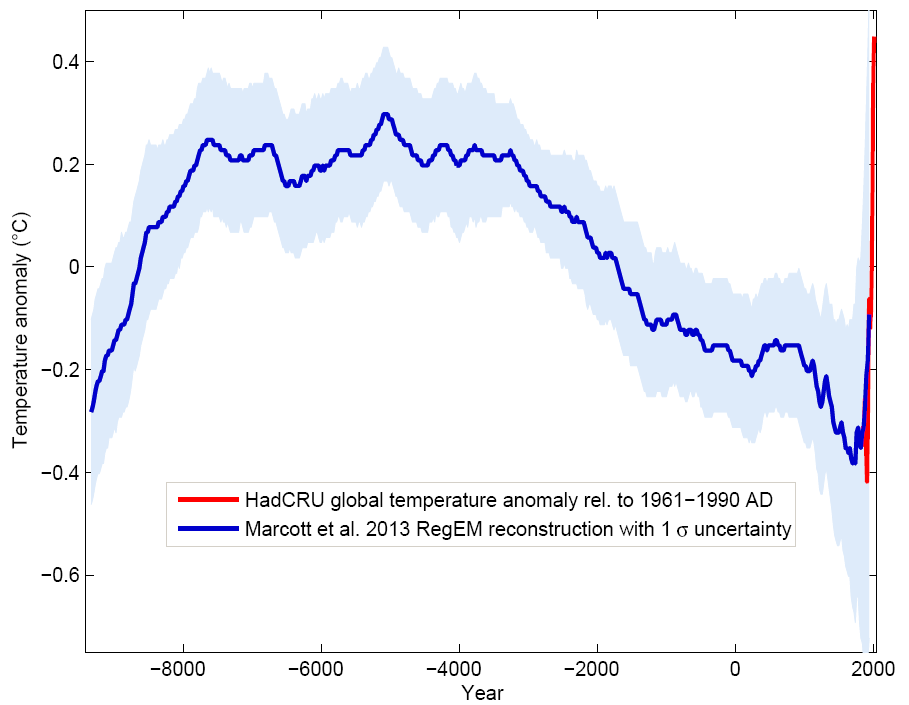
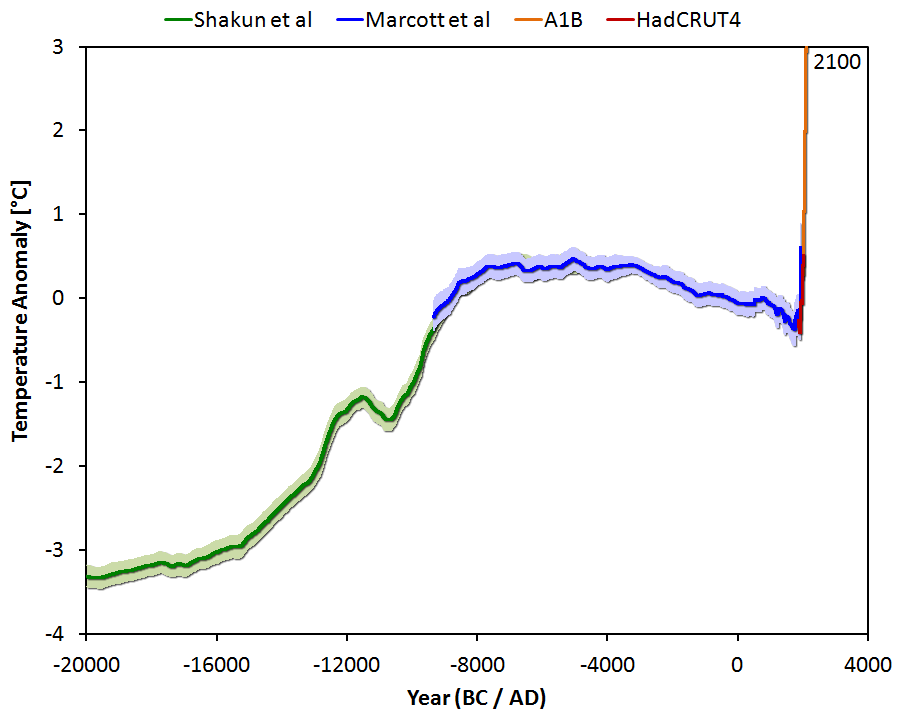
From RealClimate, a graph from the Marcott study into Holocene temperatures, which goes some way to explaining why sea ice is crashing now in a way it hasn't done since the mid Holocene (which was solar driven as further images and text on that blog post show. I strongly recommend popping over to RealClimate and reading the whole post.


And if we're foolish enough to continue emitting CO2....

Sunday, 21 April 2013

GISS LOTI and NCEP/NCAR Reanalysis.

In my last blog post (link) I outlined a recent paper that reveals some detail about the structure and cause of Arctic warming, in it I touched upon some concerns with reanalysis. It is notable that NCEP/NCAR doesn't tend to be used in studies of the Arctic, newer reanalysis products such as JRA-25 and ERA seem to be preferred by most researchers. However the reasons for this seem to be in details in literature I've not yet read, I'm not aware of any one paper throwing NCEP/NCAR temperature or pressure outputs into doubt in the Arctic. It would seem that whatever issues there are have not been enough to persuade the PIOMAS team not to use NCEP/NCAR.

But there is one issue I'm aware of; a growing mismatch between NCEP/NCAR reanalysis and GISS Land/Ocean Temperature Index (GISS LOTI).